01
Approach monitoring
Place nodes across likely routes or operating areas to detect and classify underwater activity over long periods.

Application / Defense and maritime security
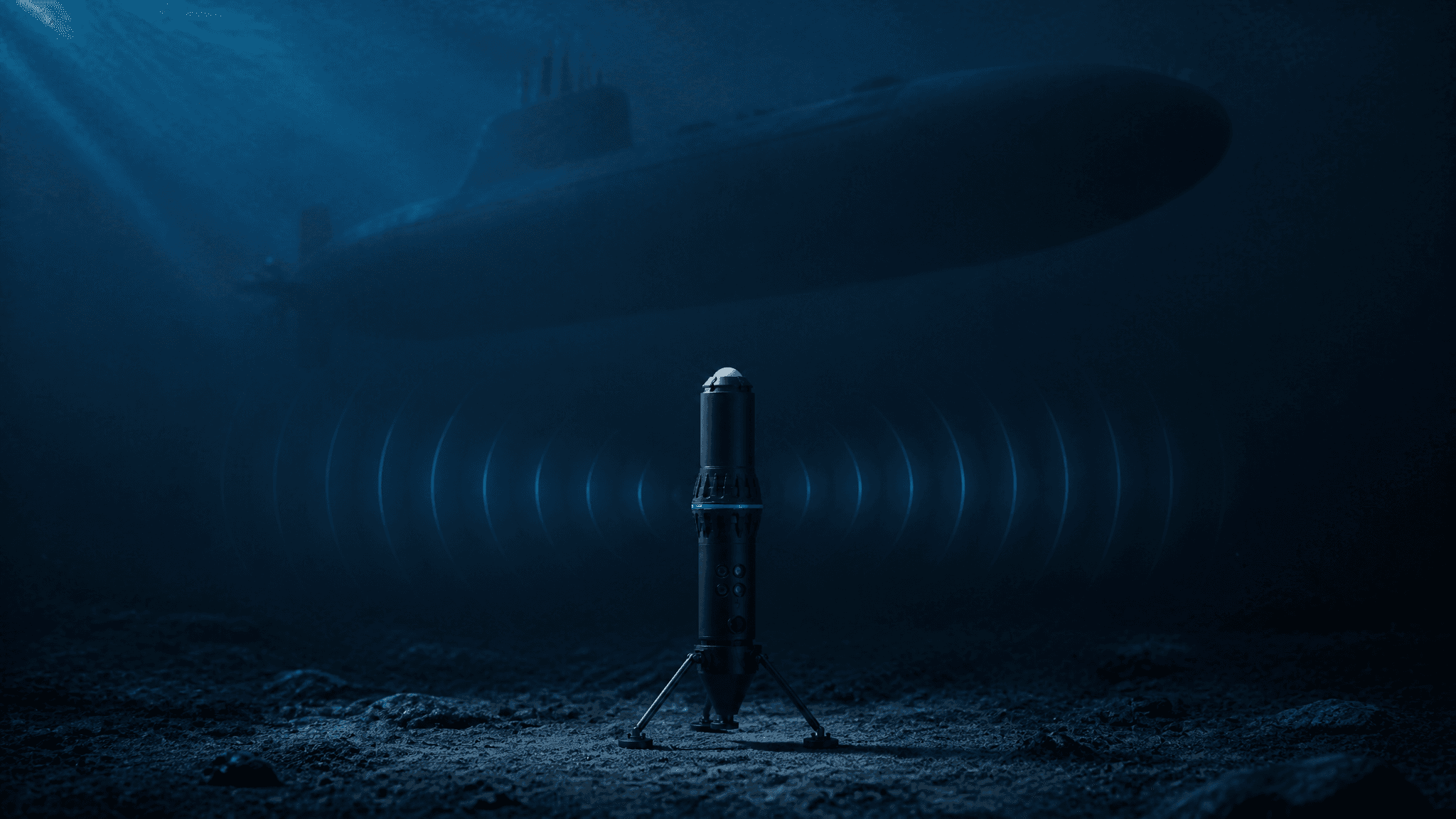
Aphotic places long-endurance intelligent nodes on the seafloor to detect activity, corroborate events across a field, communicate acoustically, and cue unmanned systems for investigation.
Underwater surveillance is usually constrained by ships, crews, and vehicles that cannot remain everywhere at once. Argus nodes descend to the seafloor and stay there for 12 to 24 months, providing stationary tripwires across approaches, protected areas, and critical infrastructure.
Each node accepts the mission sensor stack, manages its own sensing and inference duty cycle, and processes the local environment continuously. It extracts important events, compresses compact reports for acoustic links, retains the larger record, and can ask another node for confirmation or communicate directly with a UUV or ROV. Nexus sits above that edge network, maintaining the wider surface and subsea operating picture and supporting operator decisions, alerts, and tasking.
01
Place nodes across likely routes or operating areas to detect and classify underwater activity over long periods.
02
Maintain observation around cables, pipelines, ports, and other seabed infrastructure where changes or nearby activity require attention.
03
Use independent or networked seabed nodes to corroborate detections and maintain awareness across a monitored line or area.
04
Send an acoustic cue to a UUV or ROV so it arrives with a defined location, purpose, and evidence requirement instead of patrolling continuously.

System approach
The architecture is designed around the same operating needs identified for modern seabed networks: long-duration power management, modular sensing and communications, persistent local storage, node-to-node messaging, and direct interaction with underwater vehicles.
Relevant systems
Argus A, B, and X share a common seabed sensing, edge-processing, storage, power-management, and acoustic-communications architecture. Atlas services the deployed fleet, while Nexus provides the operating picture, planning, alerts, and tasking above it.